
How Well Do Attachment Frameworks Account for Neurodivergence?
Oakdale’s Senior Clinical Psychologist, Dr Jessica Guilding, and Systemic Family Psychotherapist, Victoria Butterfield, review the evidence on attachment in autistic and ADHD children. They show why traditional frameworks can miss neurodivergent ways of connecting, and how professionals and carers can build secure relationships through difference.

Introduction: Looking Beyond Our Lenses
Each of us views the world through the lens of our own lived experience. In clinical practice, particularly when working with adoptive families and Special Guardianship Order (SGO) care arrangements, professionals are often asked to evaluate complex presentations involving developmental trauma, attachment disruption, ADHD, and autism.
However, it is vital that clinicians and carers avoid binary thinking - assuming that what is familiar to us is the default "truth" and that anything outside of that norm is deficient. Research (such as Woolgar & Scott, 2013) highlights that attachment disorders are sometimes over-diagnosed in adopted children when compared to alternative or co-occurring formulations including neurodivergence. To provide meaningful clinical support, we must evaluate how well traditional attachment frameworks truly account for neurodivergent ways of being.
What the Evidence Tells Us: Autism and Attachment
Early literature (e.g., Rutgers et al., 2004) suggested that autistic children demonstrated lower attachment security overall compared to non-autistic peers. However, as research methodologies have evolved, so too has the empirical picture.
A 2025 meta-analysis by Trottier-Dumont et al., evaluating studies using the standardised ‘Strange Situation Procedure’, revealed that approximately 45.6% of autistic children were classified as securely attached. The distribution across secure, avoidant, resistant, and disorganised categories is statistically similar to general-population proportions.
Qualitative Differences and Assessment Gaps
While attachment security is present, autistic children often display distinct qualitative behavioural expressions during assessments, for example:
- Expressing less overt distress during separation.
- Displaying less conventional involvement with parents during exploration or seeking parent assistance.
- Reduced mutual gaze or prosocial responses typical of normative developmental expectations.
Meta-analytic evidence (Cossette-Côté et al., 2022) indicates an association between maternal sensitivity/availability and attachment security in autistic children and this association is twice as strong as that observed in general population samples. There is agreement in research that adaptations to assessing attachment behaviours in autistic individuals are needed but there is no consistent agreement about the adjustments needed. The research does however suggest that “different” does not mean “disconnected”. Fundamentally, relational sensitivity and availability still matter immensely.
The Relational Dynamics of ADHD
When considering ADHD, further research is required:
- Research (Dekkers et al., 2021; Wylock et al., 2023) indicates that children with ADHD show lower attachment security and a higher prevalence of ambivalent and disorganised attachment styles, but no difference in the prevalence of avoidant attachment.
- Wylock et al., (2023) however suggest that researching attachment in the ADHD population is harder as there is not one universally agreed method to assess attachment, particularly in individuals over the age of 6 when ADHD can be formally diagnosed and the different subtypes of ADHD (inattentive, hyperactive/impulsive and combined) mean individuals with ADHD have widely varying presentations. In addition they identified that other comorbidities such as parental attachment and mental health appear to influence research outcomes.
It can be remarkably difficult to disentangle where ADHD ends and relational insecurity begins. As Coughlan et al. (2022) noted in qualitative interviews with NHS child mental health professionals, differentiating attachment difficulties from autism and ADHD remains a significant diagnostic challenge.
Relational Interface: "The Winter Coat" and "The Friction Zone"
To understand why traditional frameworks can miss the mark, consider this metaphor:
1. The Winter Coat Metaphor
Imagine a parent offering their child a warm winter coat on a freezing morning. The parent notices the cold and offers warmth out of love and care. The child refuses because the lining scratches, the coat feels heavy, or their body reads temperature differently. The parent is left holding the coat as evidence of attempted care, wondering why the child rejects it.
Here, care was offered with warmth, but in a form the child's body could not receive. The offer was loving, but lost in translation.
2. The Taken-for-Granted Overlap
When the parent and child share similar embodied experiences, sensory profiles and neurotypes, understanding is effortless - like sharing a mutual dislike for a certain food or smell. Within the similarity it is possible for there to be shared assumptions which create a basis for interactions and communication; these act like shortcuts to understanding one another. But when experience does not overlap, such as a disagreement about the level of disgust produced by garden vegetables, distress can be misconstrued by the parent as ungratefulness or relational rejection, and leave the child feeling misunderstood. Reframing an argument about eating a certain food as two individuals having a different, and valid, experience of the same thing allows parents to realise: "Our bodies experience the world differently, but our connection remains".
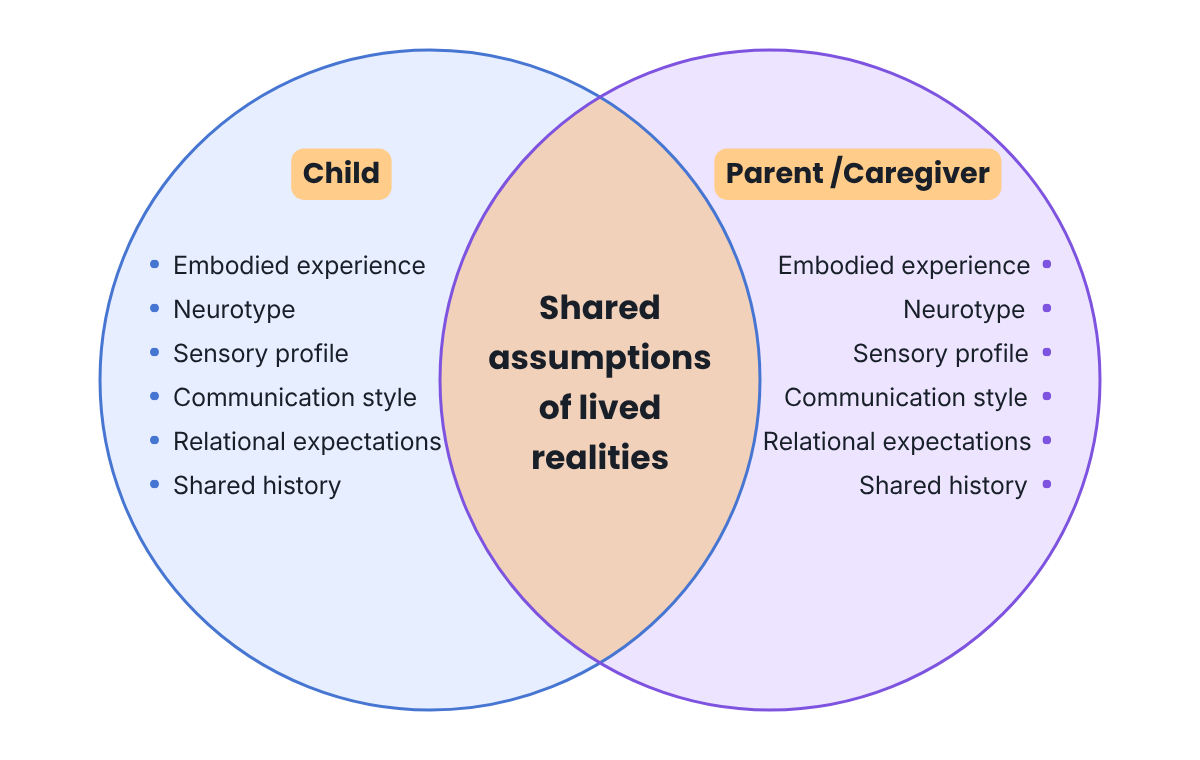
The Friction Zone & The In-Between Space
When natural overlap is minimal, there is less shared basis for understanding the world and therefore no shortcut. The lack of shared assumption is not a lack of relationship; there remains a point of relational connection, but this meeting point can also become a "friction zone”. The presence of friction and absence of overlap could be perceived as evidence of poor attachment. However, in relationships, as in nature, friction is not necessarily a bad thing. Friction costs energy, meaning progress requires effort, but it is also a necessary contact through which movement can become possible. Noticing the friction that occurs when two people come together can help to see what our current understandings or frameworks are yet to shine a light on.
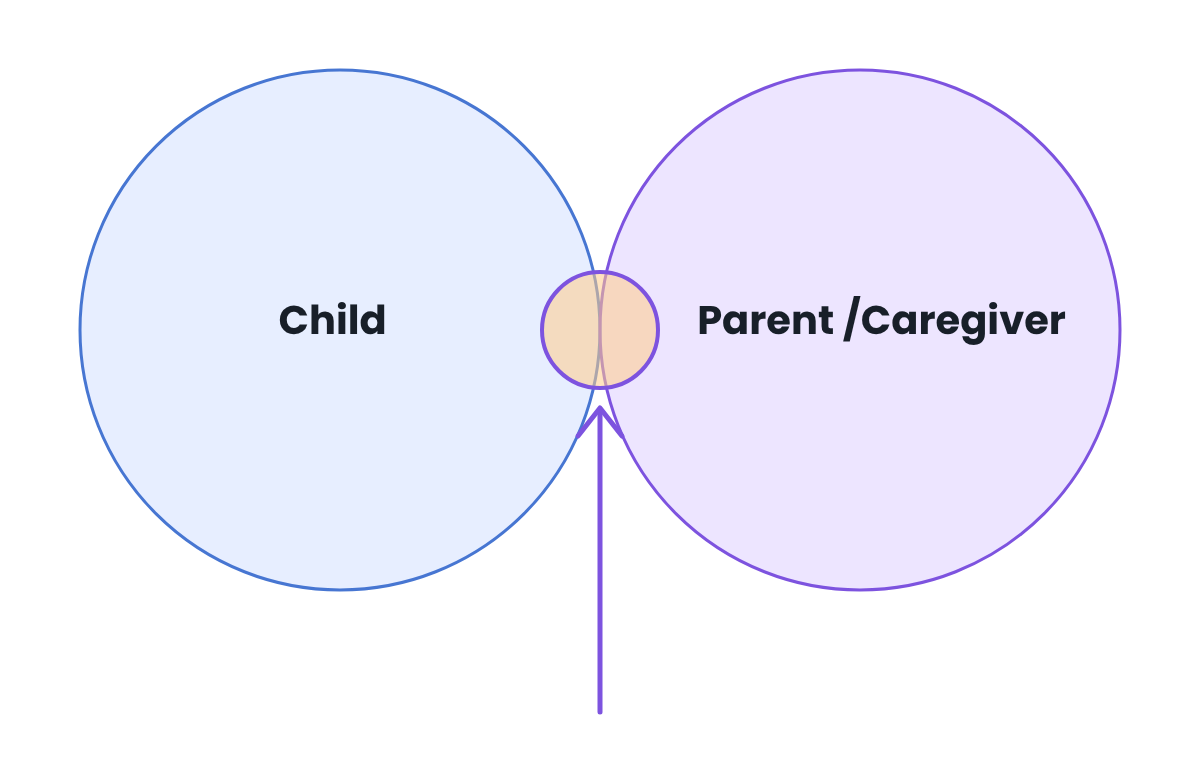
Together In Difference
As overlapping circles move apart, our professional gaze often mourns the lost overlap which held the shared assumptions. But in doing so, we ignore the space in-between - the space where meaning is actively constructed, tested, repaired, and remade together. The space in-between is a systemic relational concept focused on how meaning emerges in language (Shotter, 1993) and between people (Flaskas, Mason & Perlesz, 2005). Taking this idea of shared meaning-making as happening within the space between a parent and child lets us think what relational possibilities open up in this space. How can we be together in our differences, not in spite of them.
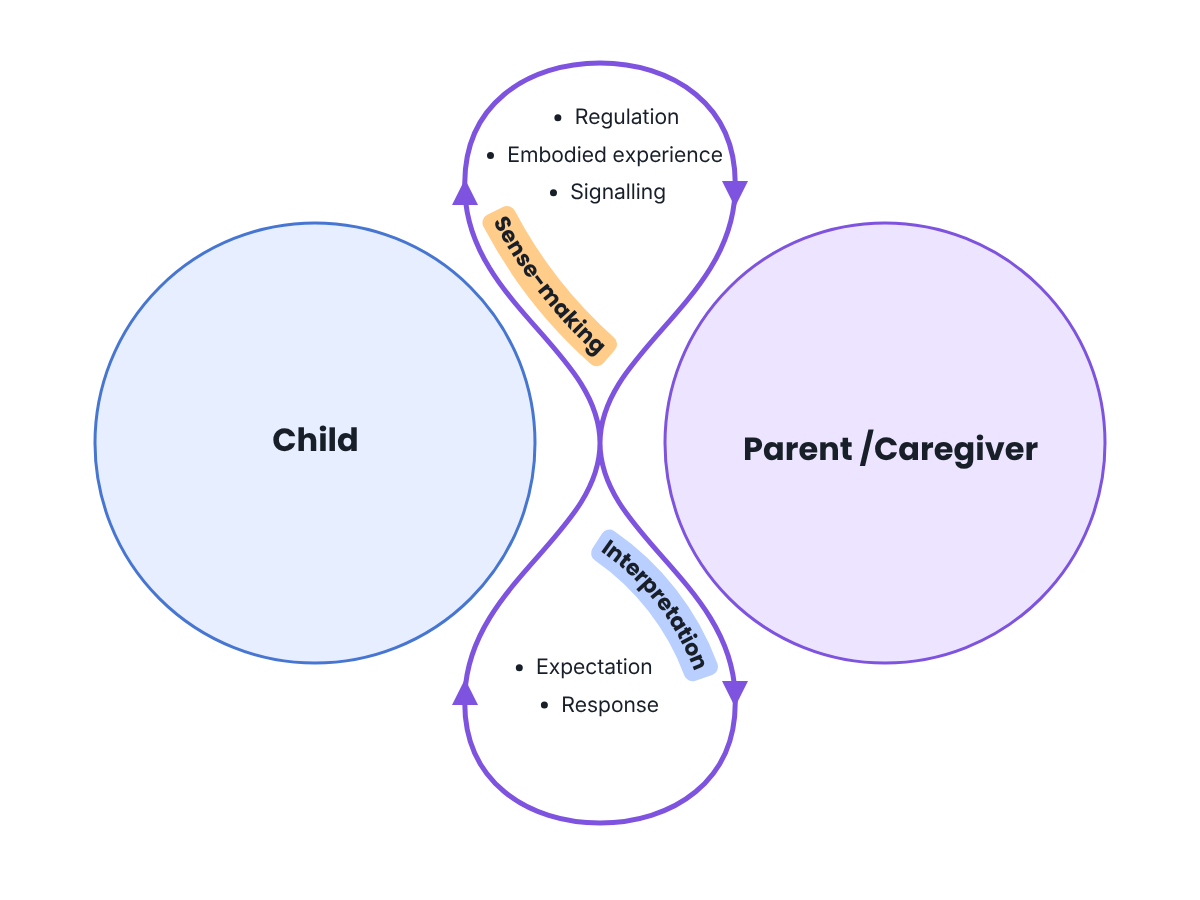
Moving Beyond the Streetlight: Reframing Attachment Questions
In Unsettling Trauma (2020), Lannamann and McNamee reference the classic parable of searching for lost keys under a streetlight simply because "the light is better there". Traditional attachment frameworks act as street lights - illuminating familiar signs of connection; proximity, eye contact, and comfort.
If we rely solely on that streetlight, we risk mistaking the limits of our framework for the limits of a family's relationship. Instead of posing a problem to be solved, the friction we experience might be inviting us to look again. What possibilities might open up if we shine a light into new places and focus on what this relationship can create? :
- If I need space, can I return?
- When we misunderstand one another, can we repair?
- Can my experience be believed even when it is unlike yours?
- Can we remain connected without requiring sameness?
At its core, the deepest attachment question for any neurodivergent individual is: "Can I be myself without losing you?"
The most secure answer any relationship can give is:"Yes. You can be fully yourself, and I am still here."
References
Cossette-Côté, F., Deneault, A.-A., Madigan, S., & Cyr, C. (2022). The association between maternal sensitivity/availability and attachment in children with autism spectrum disorder: A systematic review and meta-analysis. Current Psychology, 41(11), 8236–8248. https://doi.org/10.1007/s12144-022-03102-1
Coughlan, B., Woolgar, M., & Duschinsky, R. (2022). Differentiating “attachment difficulties” from autism spectrum disorders and attention deficit hyperactivity disorder: Qualitative interviews with experienced health care professionals. Frontiers in Psychology, 13, Article 875883. https://doi.org/10.3389/fpsyg.2022.875883
Dekkers, T. J., Hornstra, R., van den Hoofdakker, B. J., de Jong, P. J., & van der Oord, S. (2021). Attachment representations in children with and without ADHD. Brain Sciences, 11(11), Article 1516. https://doi.org/10.3390/brainsci11111516
Flaskas, C., Mason, B., & Perlesz, A. (Eds.). (2005). The space between: Experience, context, and process in the therapeutic relationship. Karnac Books.
Lannamann, J. W., & McNamee, S. (2020). Unsettling trauma: From individual pathology to social pathology. Journal of Family Therapy, 42(3), 328–346. https://doi.org/10.1111/1467-6427.12301
Rutgers, A. H., Bakermans-Kranenburg, M. J., van Ijzendoorn, M. H., & Berckelaer-Onnes, I. A. (2004). Autism and attachment: A meta-analytic review. Journal of Child Psychology and Psychiatry, 45(6), 1123–1134. https://doi.org/10.1111/j.1469-7610.2004.00305.x
Shotter, J. (1993). Conversational realities: Constructing life through language. SAGE Publications.
Trottier-Dumont, W., Bussières, E.-L., Deneault, A.-A., Madigan, S., & Cyr, C. (2025). Attachment in autistic children as measured with the Strange Situation Procedure: A systematic review and a meta-analysis. Attachment & Human Development, 27(4), 634–656. https://doi.org/10.1080/14616734.2025.2449123
Woolgar, M., & Scott, S. (2013). The negative consequences of over-diagnosing attachment disorders in adopted children: The importance of comprehensive formulations. Clinical Child Psychology and Psychiatry, 19(3), 355–366. https://doi.org/10.1177/1359104513488247
Wylock, J.-F., Borghini, A., Simas, R., & Urben, S. (2023). Child attachment and ADHD: A systematic review. European Child & Adolescent Psychiatry, 32(1), 5–16. https://doi.org/10.1007/s00787-021-01864-1
Not sure where to start?
Our clinical team can talk through your options and help you work out the right next step, whether that is for you or for someone you care about.